About the California Decision Aid System (DAS) for Navel Orangeworm
The California Decision Aid System (DAS) for Navel Orangeworm is a collaborative, science-based project designed to support Integrated Pest Management (IPM) decision-making in California tree nut production. The project adapts the proven WSU Decision Aid System framework to California conditions, crops, and pest pressures, emphasizing regional coordination and preventative management of navel orangeworm (Amyelois transitella).
This effort brings together university researchers, industry organizations, and grower-facing outreach staff to deliver timely, actionable pest management guidance at the orchard- and region-scale.
What the California DAS Is
California DAS is a web-based decision support platform designed to transfer time-sensitive pest management information to growers, PCAs, CCAs, and other IPM decision-makers in the tree nut industry.
The system runs navel orangeworm phenology and risk models, integrates real-time and forecasted weather data, and links model outputs to appropriate management and prevention strategies, including sanitation, monitoring, mating disruption, and insecticide timing.
California DAS is designed to:
- Support parcel-based orchard enrollment
- Allow users to view current and forecasted pest risk
- Facilitate data sharing across neighboring orchards
- Promote coordinated, area-wide IPM programs
Data Sources and Technology
The California DAS platform integrates multiple data streams, including:
- Weather data from CIMIS and participating private weather stations
- Forecast data from commercial weather services
- Historic weather datasets for long-term model calibration
- Grower-entered and imported data, including:
- NOW pheromone trap counts
- Orchard sanitation and management actions
- Spray applications and mating disruption deployment
- Harvest damage and processor feedback
The system is accessible on desktop computers, tablets, and smartphones (iOS and Android), allowing growers and PCAs to interact with DAS both in the field and the office.
A built-in account and data management subsystem allows users to:
- Claim and manage orchard parcels
- Select nearby weather stations
- Choose relevant pest models
- Tailor alerts and decision-support outputs to their operations
Mission Statement
The mission of the California Decision Aid System for Navel Orangeworm is to:
Provide California tree nut growers and IPM professionals with science-based, time-sensitive decision support tools that reduce navel orangeworm damage, minimize unnecessary pesticide applications, and support economically and environmentally sustainable production systems.
Strategic Vision
The development and deployment of California DAS is guided by the following principles:
- Implement science-based tools to address time-sensitive pest management challenges, with an emphasis on prevention and coordination.
- Use modern technology to simplify and expand access to IPM information for growers, PCAs, and consultants across California.
- Support area-wide pest management, recognizing that effective NOW control requires coordination among neighboring orchards.
- Collaborate with researchers, commodity groups, and industry partners to integrate validated models, tools, and management guidance into a single, user-friendly platform.
How It Works
Who Is It For?
- Tree nut growers in California (almonds, pistachios, walnuts)
- PCAs and CCAs
- Cooperative Extension and industry IPM professionals
What Does It Provide?
- Time-sensitive information on NOW development and risk
- Forecasted management windows for monitoring, sanitation, mating disruption, and insecticide applications
- Regionally aggregated trap and risk information
- Access to management guidance consistent with UC IPM recommendations
How Do Users Engage?
- Sign up for a DAS account
- Claim orchard parcels or enroll with staff assistance
- Select nearby weather stations
- View NOW model outputs and regional risk summaries
- Enter or import monitoring and management data
- Receive decision-support guidance and alerts
Project Development and Sustainability
The California DAS for NOW builds on the long-standing success of the WSU Decision Aid System, which has demonstrated industry-wide adoption, economic value, and improved pest management outcomes in tree fruit systems.
Unlike short-term research tools, this project is structured to:
- Support long-term system maintenance
- Allow incremental expansion to additional pests and crops
- Integrate grower-supported and industry-supported funding models over time
Initial deployment is supported through competitive grant funding and industry collaboration, with an emphasis on demonstrating value, adoption, and measurable pest reduction outcomes.
A Tool Used by the Industry
Through coordinated outreach and enrollment, California DAS aims to achieve broad regional adoption, recognizing that NOW management is most effective when practiced at scale.
Expected benefits include:
- Improved spray timing and reduced redundant applications
- Increased effectiveness of mating disruption through coordination
- Lower crop damage and improved quality outcomes
- Reduced management costs over time
Initial deployment is supported through competitive grant funding and industry collaboration, with an emphasis on demonstrating value, adoption, and measurable pest reduction outcomes.
How DAS Was Developed
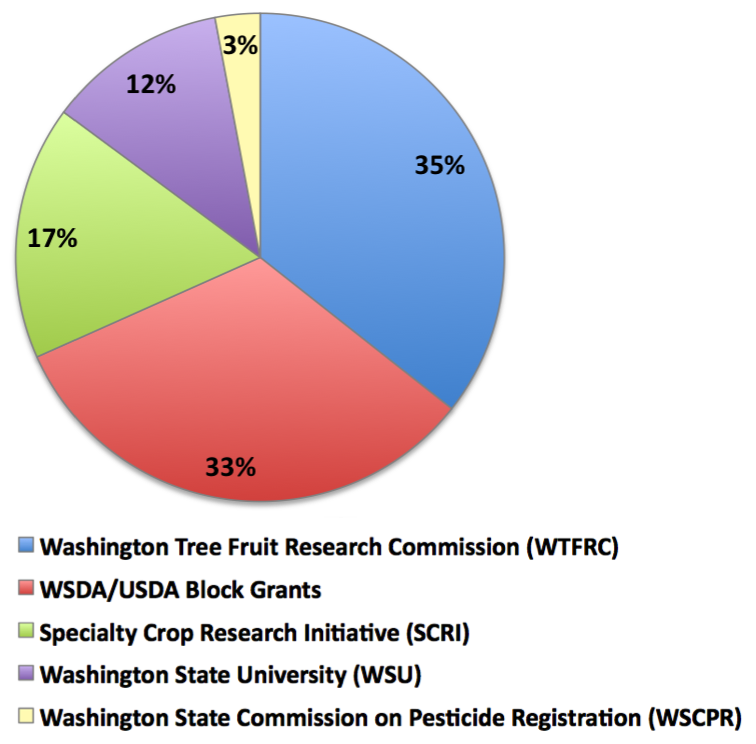
DAS was launched in 2007 with 12 models; it now includes 29 models with more in the pipeline. For the first 7 years, DAS was supported on competitively acquired grant funds from state, federal and industry funds (sources are shown in the pie chart - none of the WSU faculty time is listed).
Grants are provided by a particular agency to further the goals of that agency that also help WSU meet our land grant mission. These funds are a legal contract ensuring that WSU will meet the objectives outlined in the grants within a particular time frame (generally 1-3 years). However, these grants do not allow obligations once the granting period is over and funds are expended.
The granting agencies (including the Washington Tree Fruit Research Commission) made it very clear that they will not support projects that have any maintenance of DAS associated with them. Nor will they pay for the implementation of new features based on previous finished research. Therefore, alternative funding sources are needed to support the upkeep and expansion of this service.
Staff

Director of DAS
Associate Professor of Entomology
Washington State University

Outreach Coordinator
Washington State University

Information Systems Manager
Charlotte, NC
Software Developer & Researcher
Washington State University

Ecological Model Developer
Research Assistant Professor
Washington State University

Ecological Model Developer
Research Assistant Professor
Washington State University

Ecological Model Developer
Postdoctoral Associate
Washington State University

Ecological Model Developer
Postdoctoral Associate
Washington State University
Collaborators and previous staff

Professor of Entomology
WSU Tree Fruit Research & Extension Center

Information Systems Manager
WSU Tree Fruit Research & Extension Center

Data Scientist
Washington State University

Web Developer
WSU Tree Fruit Research & Extension Center